By Grizzly Insulation CO
If your Denver home was built between the 1940s and the late 1980s, there’s a good chance your attic has an insulation material called vermiculite. Before you call any attic insulation contractor in Denver like Grizzly Insulation CO to put insulation on top of it, you need to know what it is and why disturbing it can turn a hidden problem into a dangerous one.
What Vermiculite Insulation Actually Is
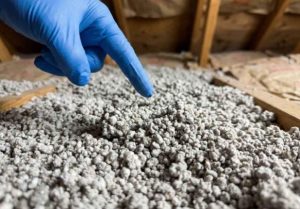
Vermiculite is a lightweight, pebble-like mineral that was poured into attics as loose-fill insulation for most of the 20th century. It’s gray-brown or silvery-gold, and it looks a bit like small, shiny gravel. Most homeowners who have it don’t know the brand name, but it was sold under one dominant label: Zonolite.
From 1919 to 1990, more than 70 percent of the vermiculite sold in the United States came from a single mine in Libby, Montana. That mine also had a natural deposit of asbestos running through it, and the two minerals came out of the ground mixed together. If your attic has Zonolite, there’s a strong chance it’s carrying asbestos fibers along with it, and you can’t tell just by looking.
Why Zonolite Insulation Matters for Your Health and What Makes Zonolite Dangerous
Asbestos is a group of mineral fibers used for decades in building materials because they resist heat and fire. The problem is that when those fibers become airborne and get breathed in, they can cause serious lung disease and cancer, sometimes decades after the exposure. There’s no known safe level.
Vermiculite sitting quietly in an undisturbed attic isn’t actively hurting anyone. The Environmental Protection Agency is direct about this: the material is only dangerous when its fibers become airborne, which happens when it’s disturbed. Walking through it. Scooping it. Blowing new insulation on top of it with equipment that stirs up the layer underneath. Running a vacuum near it.
That means the moment you decide to upgrade your attic insulation, you’ve created exactly the kind of disturbance that turns a stable, contained material into an airborne hazard. A well-meaning crew that isn’t looking for vermiculite, or doesn’t know what it looks like, can walk straight into your attic and start working on top of it.
What to Do If You Find Zonolite in Your Denver Attic
Here are a few steps you can take to tackle Zonolite in your Denver Attic safely. Follow these to maintain the health and safety of everyone.
Don’t Test It Yourself
Don’t try to confirm it by digging around or collecting a sample. The Environmental Protection Agency specifically advises against opening things up to check, because sampling incorrectly is itself a disturbance, and lab testing of vermiculite can come back with a false negative even when asbestos is present. If what’s in your attic looks like small, shiny, gray-brown or gold pebbles, the safest assumption is that it’s Zonolite, and the safest approach is to treat it as if it contains asbestos, full stop.
Leave It Completely Undisturbed
Don’t store boxes on it, don’t let anyone dig through it looking for old wiring, and don’t schedule an insulation upgrade without mentioning it first.
Tell Your Contractor Before They Show Up
This is the step homeowners skip most often. Ask directly whether your contractor checks for vermiculite as a standard part of every attic job. A contractor who doesn’t ask, or doesn’t know what it looks like, isn’t the right choice for a Denver attic built in this era.
A vermiculite check is built into the first step of every attic insulation service in Denver our team at Grizzly Insulation CO performs. Denver has an enormous amount of housing stock from precisely the decades this material was sold, and walking into an attic without checking for it first isn’t just careless; it’s a serious health risk. If we find something that looks like Zonolite, we stop, tell you exactly what we’re seeing, and point you toward proper testing or certified abatement before any new insulation goes in.
Conclusion
If you’re planning to upgrade your Denver attic’s insulation, and your home was built any time between the 1940s and the late 1980s, ask about Zonolite before you ask about R-value or pricing. It’s the question that actually protects your family, and the one that separates an insulation contractor rushing to close a sale from one actually looking out for you.