
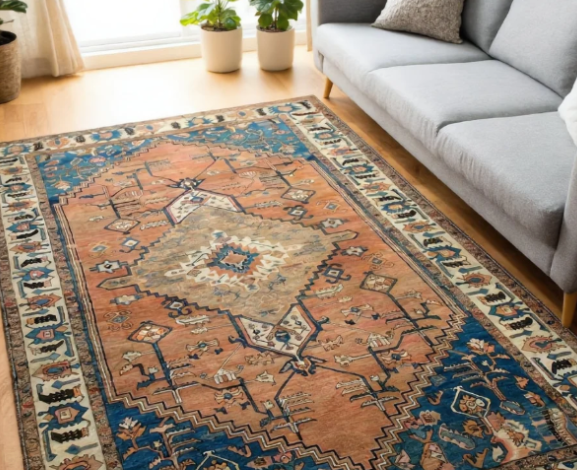
A carpet can cost a few thousand rupees or several lakhs. Both can be perfectly reasonable purchases, depending on what is being bought. The difficulty begins when buyers compare products using only their dimensions, photographs, or material labels.
A 5 × 7 ft carpet is not automatically comparable to another 5 × 7 ft carpet. One may be machine-made, another hand-tufted and a third hand-knotted. Their materials, construction time, detailing, and finishing can differ considerably.
Understanding carpet prices therefore requires looking beyond the number on the product page. It means understanding what contributes to that number, and whether those qualities matter in the room where the carpet will actually live.
What Actually Determines Carpet Prices?
There is no single price formula for every carpet. Several production and product decisions influence its final cost.
| Price factor | What it changes |
| Construction | Hand-knotted, hand-tufted, hand-woven and machine-made carpets involve different production processes and labour requirements. |
| Material | Wool, silk, cotton, jute and synthetic fibres have different properties and costs. Blended materials introduce further variation. |
| Design complexity | Detailed patterns and multiple colour changes can require additional planning and production work. |
| Knot density | In hand-knotted carpets, greater knot density can allow finer detail, but it is not an independent guarantee of quality. |
| Finishing | Washing, trimming, stretching, backing, and edge finishing affect the finished product. |
| Size | Larger dimensions generally require more material and production time, although construction and design also influence cost. |
The distinction between construction methods is particularly important. A hand knotted carpet is made by tying individual knots around warp threads. A hand tufted carpet is produced by inserting yarn into a backing using a tufting tool. Both are handmade processes, but they are not interchangeable.
India’s Bhadohi carpet cluster illustrates the complexity behind the first category. The Government of India’s handicrafts documentation describes its vertical-loom weaving process, yarn selection, and design traditions. Bhadohi handmade carpets also hold a Geographical Indication registration.
Why Two Carpets Made from Wool Can Have Very Different Prices
The word wool tells a buyer something about the fibre, but very little about the complete product. Consider two wool carpets. One is a relatively simple flat construction with a restrained pattern. The other is hand-knotted, has a detailed design and requires substantially more weaving work.
Both contain wool, yet their production requirements are different. The same applies to silk blends, cotton constructions and synthetic carpets. Material should be evaluated alongside construction, pile, finishing and intended use.
A useful question to ask a seller is: What exactly am I paying for beyond the fibre?
A meaningful answer should explain the construction, material composition and relevant workmanship. Simply describing a carpet as premium or handmade does not provide enough information to judge its price.
The Mumbai Apartment, the Jaipur Drawing Room and the Cost of Buying Wrong
A carpet’s value also depends on the household’s furnishing priorities.
In a Mumbai 2BHK, the living room may be the principal shared space for television, visitors and everyday family use. A buyer may prefer one well-made carpet that fits the seating arrangement rather than spending the same budget on an oversized piece that interferes with dining chairs and movement.
In a Jaipur villa with a separate drawing room, the decision can be different. A larger seating arrangement may justify a more substantial carpet, while a second family lounge may need a simpler, easier-to-maintain option.
Budget priorities vary just as much. A middle-income household may be balancing a carpet purchase against curtains, appliances, or furniture. A premium homeowner may already have the furniture and be looking for a particular design or construction. In a luxury interior, a bespoke carpet may be commissioned around the room’s dimensions and furnishing scheme.
None of these households automatically needs the most expensive option. Their requirements are different. The expensive mistake is paying for qualities that the room, the household or the intended use does not actually require.
What Should You Check Before Paying the Price?
A product photograph cannot establish every aspect of carpet quality. Before purchasing, check these five details:
- Construction: Confirm whether the carpet is hand-knotted, hand-tufted, hand-woven or machine-made.
- Material composition: Ask for the actual fibre percentages, especially when the description says wool blend or silk blend.
- Dimensions: Check the finished measurements rather than relying on a nominal size.
- Back and edges: Examine the backing, binding and finishing for signs of uneven workmanship.
- Colour and surface: Ask about colourfastness, expected shedding and care requirements, particularly for high-pile or darker carpets.
For a substantial purchase, request clear product specifications and close-up photographs. If the seller cannot explain the construction or material composition, a premium price is difficult to justify.
A Carpet Is Worth Its Price When You Understand What You Are Buying
India has a substantial handmade carpet industry, supported by production clusters such as Bhadohi and Mirzapur. Its range extends from Persian yellow carpets to handwoven modern rugs, serving very different design and budget requirements. That variety is precisely why a single price benchmark is misleading. A well-priced machine-made carpet and an expensive hand-knotted carpet are not necessarily competing for the same buyer.
When comparing carpet prices, look at construction, material, workmanship, and the demands of the room together. Whether the choice is a detailed traditional design, a contemporary abstract piece, or one of the more distinctive yellow carpets, the purchase should make sense beyond its appearance on a product page.